The “Unfinished” page gathers together several ruins where fragments of information survive but not enough to warrant a full entry. These sites remain part of the wider Anglezarke story, each with its own character and traces of history. Though incomplete, they offer valuable glimpses into the lives of families and farms now long gone.
Drinkwaters
According to the Anglezarke Sources Book in Chorley Library, it was common for farmers here to have another occupation, with wives and daughters often working on the looms. In 1821, the tenant of Drinkwaters sent a consignment of barytes illegally to France. Barytes were used in the bleaching process of paper, and the profit was £5. George Dixon, a Rural District Councillor, lived for some time at Manor House Farm but slept at Drinkwaters during lambing. Like other abandoned farms, Drinkwaters was later used as bombing target practice in preparation for war.
Coppice Stile House
Coppice Stile House lies on the way up to Great Hill from White Coppice. Following the dry stone wall down to Black Brook reveals remnants of another unnamed ruin nearby. Here, Black Brook is referred to as Dean Black Brook, and Grange Water further upstream.
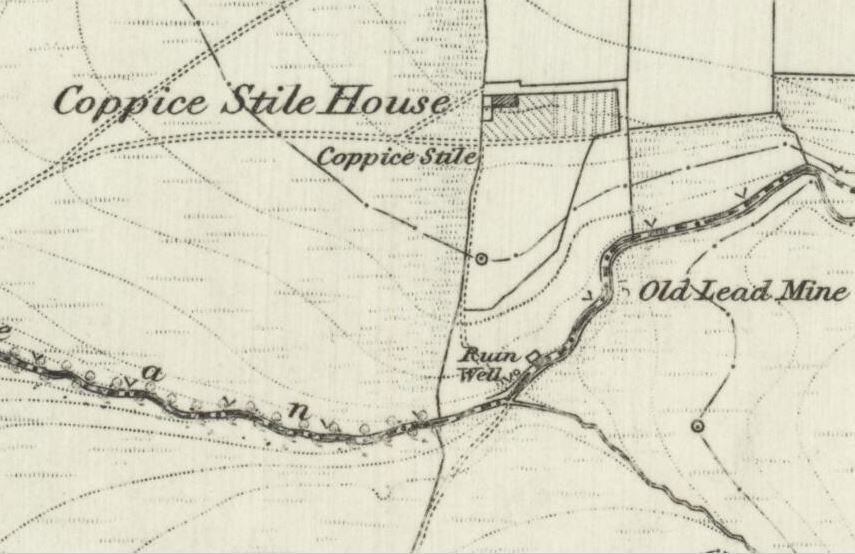
Locals sometimes called the farm “Copy Stile,” with White Coppice as “White Copy” and Black Coppice as “Black Copy.” Surprisingly, Coppice Stile was once a pub, though its name is unknown. Its location, high on the hills, may have been chosen to avoid Alfred Ephraim Eccles, the White Coppice mill owner and a rabid advocate of the temperance movement.
Alance
Alance Bridge marks the confluence of Limestone Clough and the River Yarrow, at the inlet to Yarrow Reservoir. Before the reservoir, the river and bridge were already here, though the current bridge replaced an older one demolished during construction.
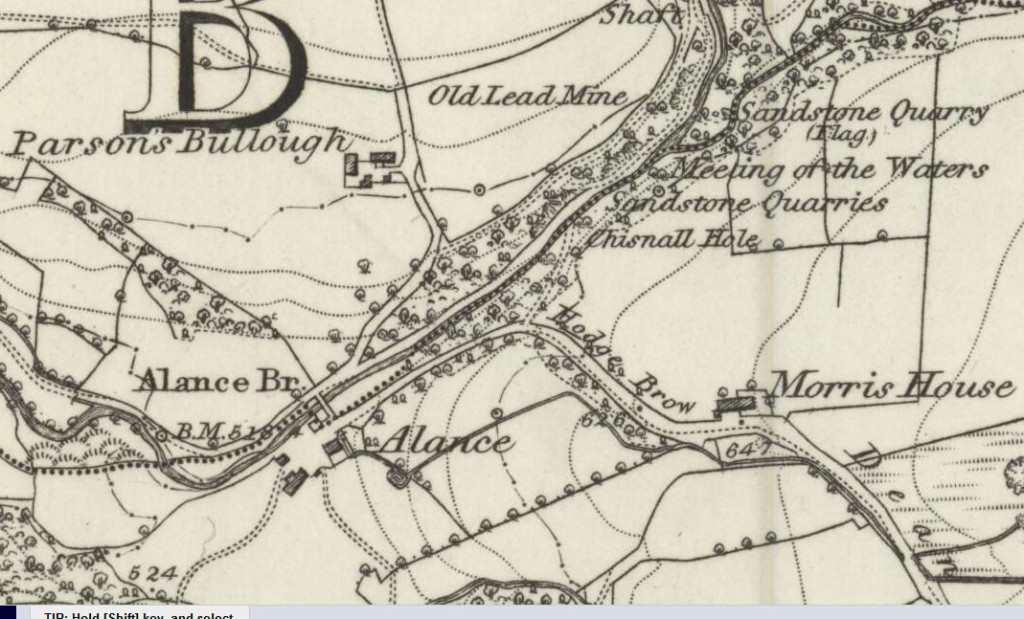
The farm at Alance, along with Turner’s and Anderton’s, was removed when the reservoir was built. George Birtill’s Heather in my Hat describes how the old bridge and part of the road can still be seen. Records note that the reservoir was first dammed with a small embankment, later replaced in 1868 by a much larger one, 103 feet high. The Lancashire Online Parish website lists residents in 1841, including John Ashcroft, Ann Chisnall, Ellis Brooks, James Dewhurst, and others. Rawlinson’s book adds that the bridge was named after the Alance family, who farmed nearby. Hearth Tax returns for Rivington in 1663 record Thomas Alance paying two shillings for one hearth.
Pilkingtons
On 15 January 1895, the Horwich Chronicle reported the sale of the property. Richard Shaw of Rivington paid £410 for “Equal undivided third part or share of the messuage and dwelling house called ‘The Pilkington’s’, Rivington, and the land occupied therewith.” Later, on 9 July 1904, Liverpool City Council decided to buy Pilkington’s along with Jepson’s Farm, as part of its reservoir catchment acquisitions.
Haddock Fold
Haddock Fold is recorded in detail by the Chorley Historical and Archaeological Society. Their article describes the farm’s history, layout, and decline, preserving evidence that might otherwise have been lost.
Morris House Farm
On 20 October 1894, the Horwich Chronicle reported a robbery at Morris House Farm, the home of Mr. and Mrs. John Taylor. Silver was taken, and the thieves helped themselves to bread, butter, and cream. The house was gone not long after the turn of the century. Though evidence of the original farmholders is scarce, records mention an Obadiah Morris of Anglezarke in the 18th century.
Present Day
These ruins remain fragmentary, with only scattered references in books, maps, and newspapers. Some, like Alance, were erased by reservoir construction; others, like Drinkwaters and Coppice Stile, survive only in partial remains. Together, they form the “Unfinished” chapter of Anglezarke’s history — incomplete, but still vital in understanding the broader story of the moors.