Turners Farm once stood at the southern end of what is now Yarrow Reservoir.
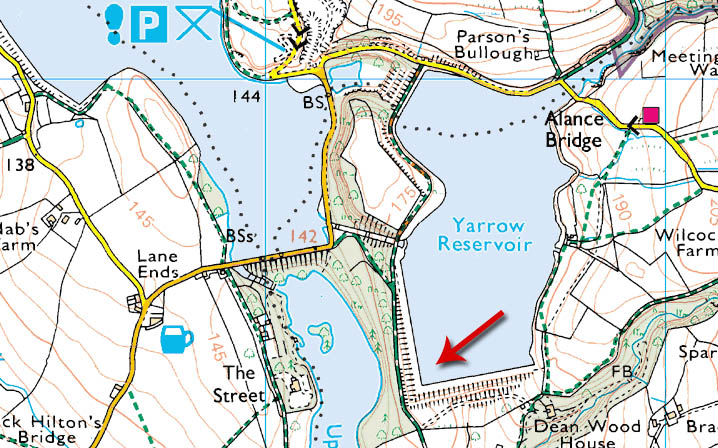
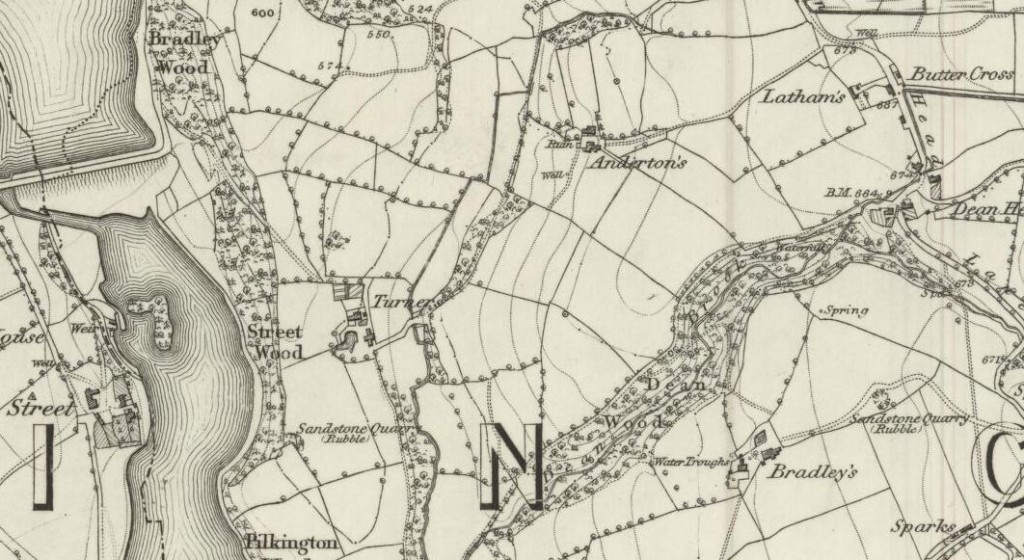
The name survives today in Turner’s Embankment, though the farm itself was swallowed up when the reservoir was constructed. Old maps preserve its outline, and even the punctuation of the name varied over time, reflecting the inconsistent use of apostrophes in the 19th century.
Families & Residents
The Turners were long associated with the site, though by the late 19th century the farm had already fallen into obscurity. The surrounding belt of ruins suggests a cluster of activity, with Dean Wood nearby providing both resources and shelter. The Nightingale family, known locally for blacksmithing, may have worked in connection with the tanning pits discovered at Turners, linking the farm to wider trades in the area.
Archaeological Discoveries
In the autumn of 1874, workmen for the Liverpool Corporation uncovered a remarkable series of tanning pits while removing earth near the farm. Eight Tam Pits were found in total: six lined with decayed boards and two with stone. Each was flagged at the bottom and measured roughly five feet by four and a half feet, with a depth of five feet. The timber was pegged together, and the sediment contained bark, lime, hair, and fragments of crockery.
Nearby, a beaten circular track about six or seven metres in diameter was discovered, referred to as a “cock pit.” This was where bark was crushed for tanning hides. The finds confirmed that leather‑working had once been a communal activity here, with farmers tanning their own hides — and perhaps those of neighbours — before selling them at market.
Mapping & Landscape
To the east of Turners Farm lay Booth Bank, a long field alongside Dean Wood. At the lower end of this field, beneath the “e” of Turners on the old map, a wall foundation was found, possibly part of a shed associated with the tanning work.
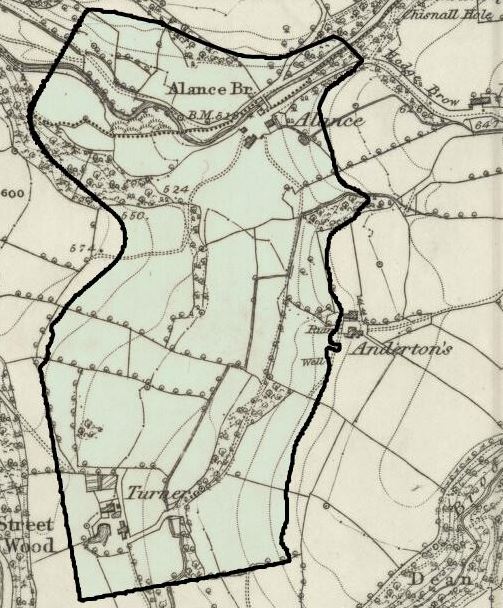
The 1849 Ordnance Survey map shows Anderton’s Farm nearby, with the later reservoir border added for comparison.
Decline & Ruin
By the late 19th century, even the occupants of 1874 were unaware of the tanning pits’ existence, suggesting the practice had long ceased. Liverpool Corporation’s acquisition of the land for water catchment sealed the fate of Turners. The farm, like Alance, was completely engulfed by Yarrow Reservoir.
Present Day
Today, nothing of Turners Farm remains above ground. Its memory survives only in the name Turner’s Embankment and in the archaeological record of the tanning pits. The surrounding Dean Wood retains its own stories, from Mrs. Swithells’ complaints about footpaths in 1898 to its later closure by Liverpool Corporation in 1905. The woodland was once described as “a fine, undisturbed oakwood, probably the most interesting piece of oakwood in the region,” and remains the only known nesting site for the Pied Flycatcher in Lancashire.