Wilkinson Bullough was one of the oldest farms on the Anglezarke moors. Records show it was standing at least as early as 1626, alongside other ancient homes such as Jepson’s, Higher Bullough (Manor House), and Stones House.
At that time, the property was written into the will of John Bulhaugh, confirming its existence in the early seventeenth century.
Families & Residents
By 1757, Wilkinson Bullough covered 27 acres, a size that remained consistent for another hundred years. In 1851, census records note that handloom weaving was a secondary occupation for the farmers living here, reflecting the dual economy of agriculture and textile work common across the moors.
The farm was not without its darker moments. On 30 November 1872, the Chorley Standard reported that Richard William Entwistle was sentenced to six months in prison for breaking into Wilkinson Bullough, then owned by William Marsden, farmer. Entwistle stole a blue coat, a black cloth vest, handkerchiefs, one pound of butter, and a pound of sugar.
Nine years later, the property was shown as unoccupied, though by 1881 it was lived in again, albeit with rents reduced by 60 percent compared to earlier decades.
Farming & Daily Life
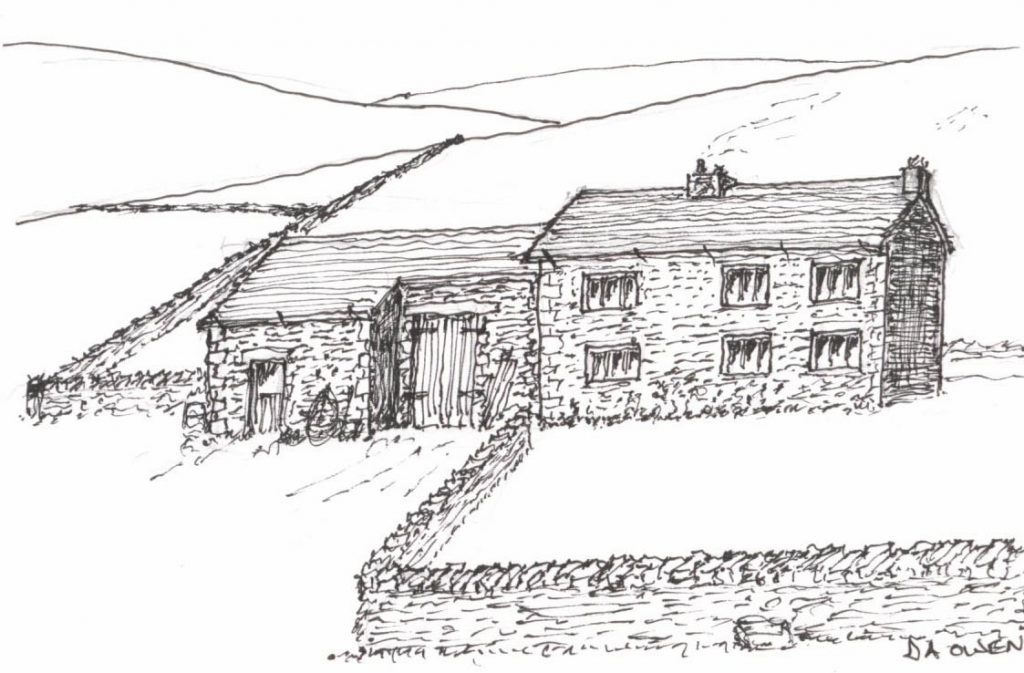
Wilkinson Bullough was a substantial farmstead. Like Old Rachel’s and Stoops, it was described as a large house with the barn joined to the house as an extension. Families here combined farming with weaving, and the land supported both pasture and crops.
Architecture & Features
The design of Wilkinson Bullough was known as a longhouse, with the barn attached directly to the dwelling. It is not known whether it had a cross‑passage — a passage linking the front and rear doors — though D.A. Owen’s sketch of the property does not show a clear front entrance. The longhouse style was not reckoned to be particularly common in the West Pennine Moors, presumably because it offered little shelter from the prevailing winds.
By 1936, the farm was ruined to the point that a large elder tree was growing up through the centre of the house. Until relatively recently, it was still possible to trace the general outline of the longhouse on the ground.
Decline & Ruin
The decline of Wilkinson Bullough followed the wider pattern of abandonment across Anglezarke. As farming became less viable and Liverpool Corporation acquired land for water catchment, families moved away. By the early twentieth century, the farm was already ruinous, with only outlines and fragments remaining.
Present Day
Today, Wilkinson Bullough survives only as a ruin. The elder tree that once grew through the centre of the house symbolises its decay, but the outlines of the longhouse can still be traced. Together with Old Rachel’s, Stoops, and Coomb, it is remembered as one of the larger houses of the moors, its barn joined to the dwelling in a distinctive style. Though the walls have crumbled, Wilkinson Bullough remains part of the story of Anglezarke — a farmstead that endured for centuries before succumbing to decline.